Building intelligence for organizations
Building intelligence that stays with the building.
See what needs attention across every building, what changed and what may need funding next, from one record of equipment, work and evidence kept useful for every party who touches the building.
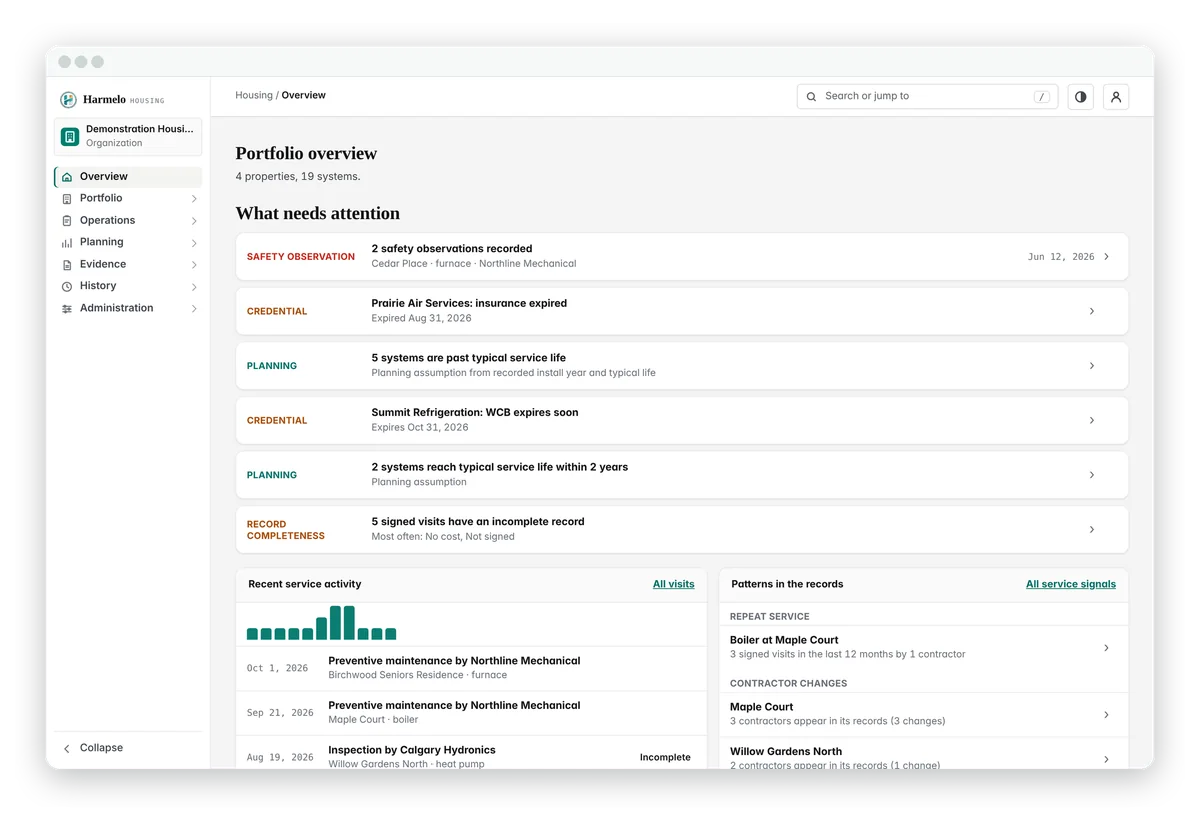
- Know itBuildings, equipment and every signed visit, in one record.
- Operate itWhat needs attention or funding, with its reason, and what was done.
- Preserve itHistory that outlasts staff, contractors and subscriptions.
- Pass it onThe record moves to the next owner or operator, with its provenance.
The infrastructure underneath
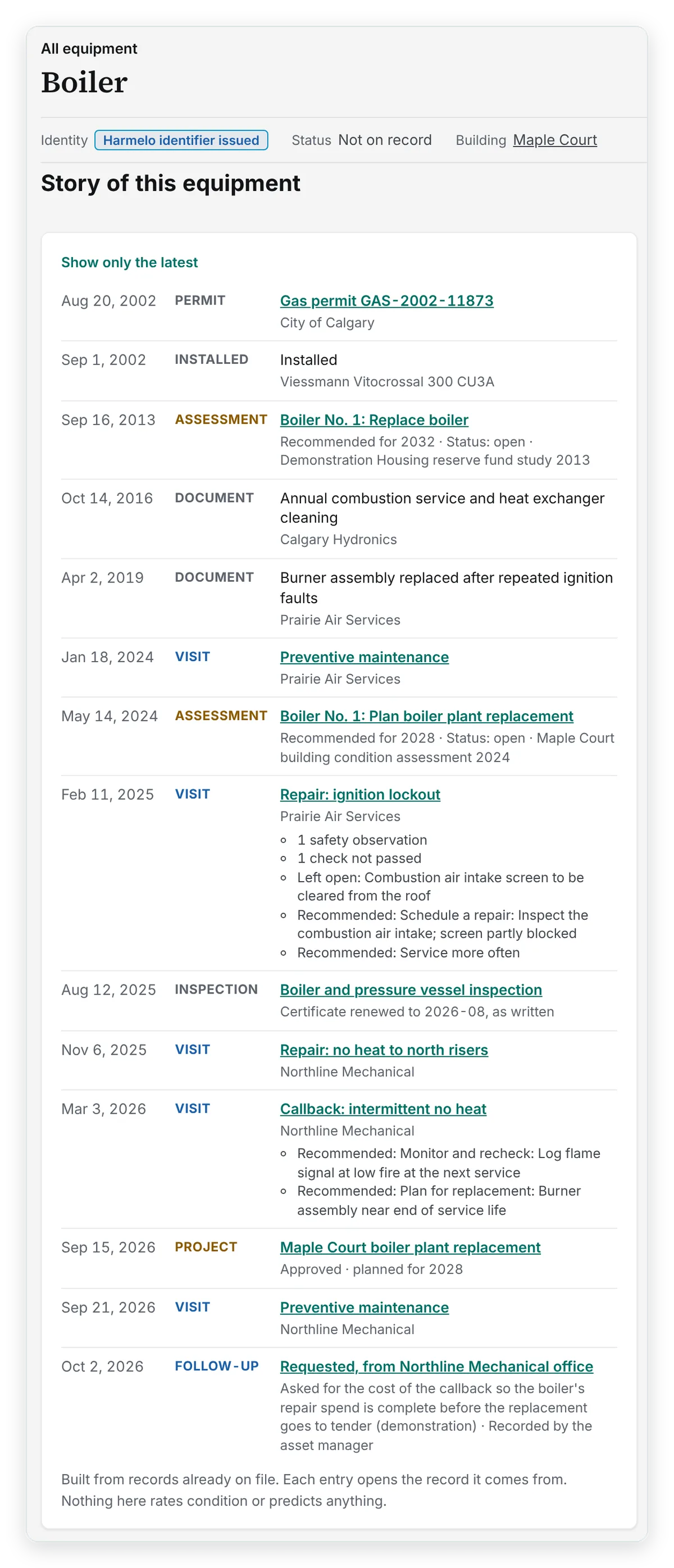
Every building and every piece of equipment keeps one continuing identity, with its history attached.
A work-order system tracks tasks. A dashboard summarizes them. Harmelo keeps the asset itself: each building and each unit of equipment carries a Harmelo identifier, and every visit, document, assessment and decision is attached to it with where it came from. The operational, capital and portfolio intelligence you see is read from that record, so it carries on through a change of contractor, staff, operator or owner.
- IdentityEach building and each unit gets an identifier that is never reused or reissued, so a boiler's history cannot drift onto the unit that replaces it. These are Harmelo's own record identifiers, not a government or other official registration.
- ProvenanceEvery fact says what it rests on: a signed technician visit, a document a person accepted in evidence review, an entry or import, or an engineering assessment. Who recorded it, and when, is kept in Audit.
- ContinuityVisits are filed against the identified unit by the company and technician who did the work. When a contractor, staff member or operator changes, the history stays with the equipment.
- Authorized transferWhen a building changes hands, the outgoing organization proposes a custody transfer, the receiving organization accepts and carries it out, and the outgoing organization's access ends. Both organizations' Audit records each step.
- Knowledge keptManuals, warranties, permits, assessments and the reasons behind past decisions stay with the building. If paid service ends, Harmelo staff move the organization's account to read-only rather than deleting it.
What Harmelo helps you do
Decide from what is known about your buildings, not from what someone remembers.
Every building you are responsible for, on one screen. Each item carries its reason and the evidence behind it, and where there is not enough evidence the record says so, rather than having gaps guessed at or quietly averaged in.
An estimated replacement window is a planning assumption, not a prediction of failure. Estimates should be reviewed alongside current inspections, professional advice and the organization's own planning requirements.
Works alongside your CMMS and property-management system
Keep the systems that run the work. Add the record that outlasts them.
Most organizations already have a system for work orders and another for leases, tenants and payables. Harmelo does not replace either. It keeps what they were not built to keep: the identity and governed history of each building and its equipment, across every contractor, system and owner.
Existing equipment lists and service records come in through import and are marked as imported, not as documented. Harmelo has no live connector to another named product today; connections are scoped with technology partners.
Product in action
Four workflows, shown in the real product.
Current Harmelo screens in a fictional demonstration organization. Each one shows what you see, and what it lets you decide.
What needs attention
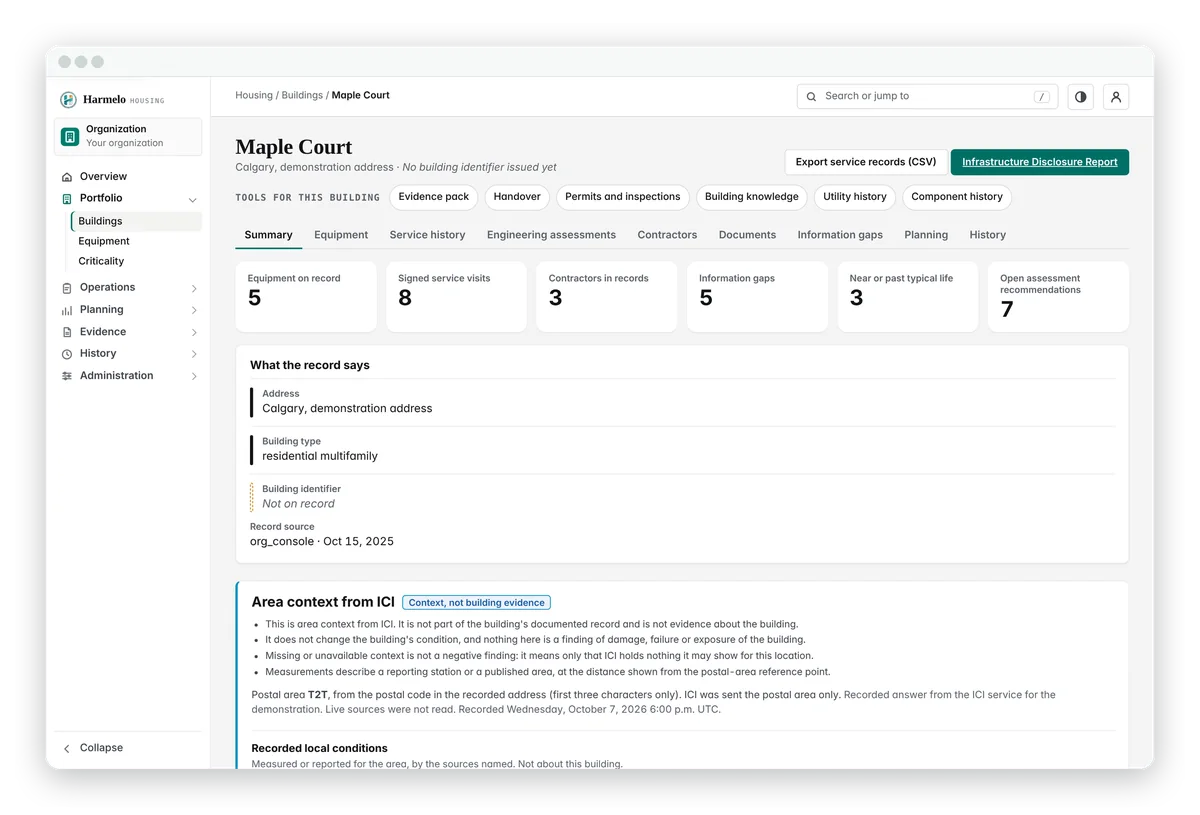
- The problem
- Open recommendations and missing documents sit in reports nobody reopens.
- What Harmelo does
- Each building shows what is open, what is missing and what changed, every item with its reason and source.
- The outcome
- Attention goes to what is documented as open, before it becomes an emergency or an unfunded surprise.
Equipment history
- The problem
- When a contractor changes, the service history leaves with them.
- What Harmelo does
- Every signed visit is filed against the unit it was done to, by the company and technician who did it.
- The outcome
- The next contractor starts where the last one finished, instead of diagnosing from scratch.
Capital planning
- The problem
- Every reserve study rebuilds the equipment inventory from scratch.
- What Harmelo does
- Installation dates, service history, engineering evidence and documented costs stay with each asset, and the reserve planner compares lower, base and higher scenarios.
- The outcome
- The next plan starts from what is already known, for review with the professionals who prepare it.
Field to office
- The problem
- Field notes arrive incomplete and are retyped in the office.
- What Harmelo does
- The technician records readings, photos, findings and required sign-offs at the equipment; the office sees what each record still needs.
- The outcome
- Information is captured once and is ready for the owner, the office and the next technician.
Who Harmelo serves
Built for the organizations responsible for buildings, and the professionals who work on them.
Everyone contributes. Everyone benefits. The history stays with the property.
Professionals and partners
How it works
One record per building that gets more useful every time work happens.
- 1CaptureTechnicians, contractors and staff record work at the equipment, with readings, photos, documents and who did it.
- 2PreserveEach entry stays with the building and its equipment, with its source and evidence, through every change of hands.
- 3UnderstandThe record shows what needs attention, what changed, what repeats and what may need funding, each with its reason.
- 4ActFollow-ups, capital plans, handovers and evidence packs start from the record instead of a search through inboxes.
Missing information is shown as missing and is never treated as a defect. The record does not diagnose equipment, predict failure or replace a qualified professional's judgment.
Continuity
The software can change. The building history stays.
Staff leave. Contractors change. Properties sell. Subscriptions end. Harmelo keeps the record attached to the building and its equipment, so the next person starts from what is already known instead of rebuilding it from scratch.
- Owner ACommissions the building and its records
- Operator AInstalls, services and documents for years
- Contractor AFiles every visit at the equipment
- Operator BTakes over with the history, not a blank screen
- Contractor BStarts from the last visit, not from rediscovery
- Owner BBuys the building and its memory
When a staff member leaves
The record belongs to the organization, not to a person. Their visits, notes and decisions stay on the building with who recorded them, and their access ends when you remove it.
Otherwise lost: what one person knew about the building.
When the contractor changes
A new contractor you authorize works from the equipment, its service history and its open recommendations. Contractor access is yours to grant and to end; it never carries over on its own.
Otherwise lost: the service history that left with the last vendor.
When the operator or manager changes
Once the owner gives a new operator access, or moves the building to the operator's organization by custody transfer, the operator starts from the equipment, service history, documents, evidence, warranties, permits and capital projects on record. The record carries its provenance with it.
Otherwise lost: years of history rebuilt from inboxes and memory.
When the property sells
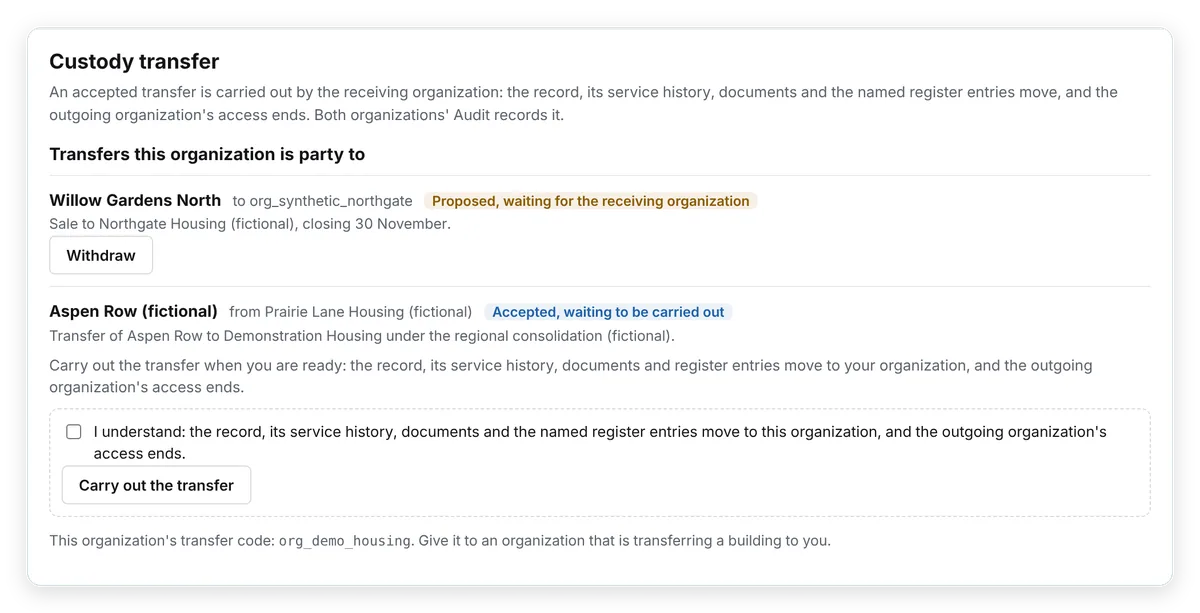
The building's record moves to the receiving organization by an authorized custody transfer: proposed, accepted and audited on both sides, with a manifest of what moves and what stays.
Otherwise lost: the warranties, manuals and open items the building already paid for.
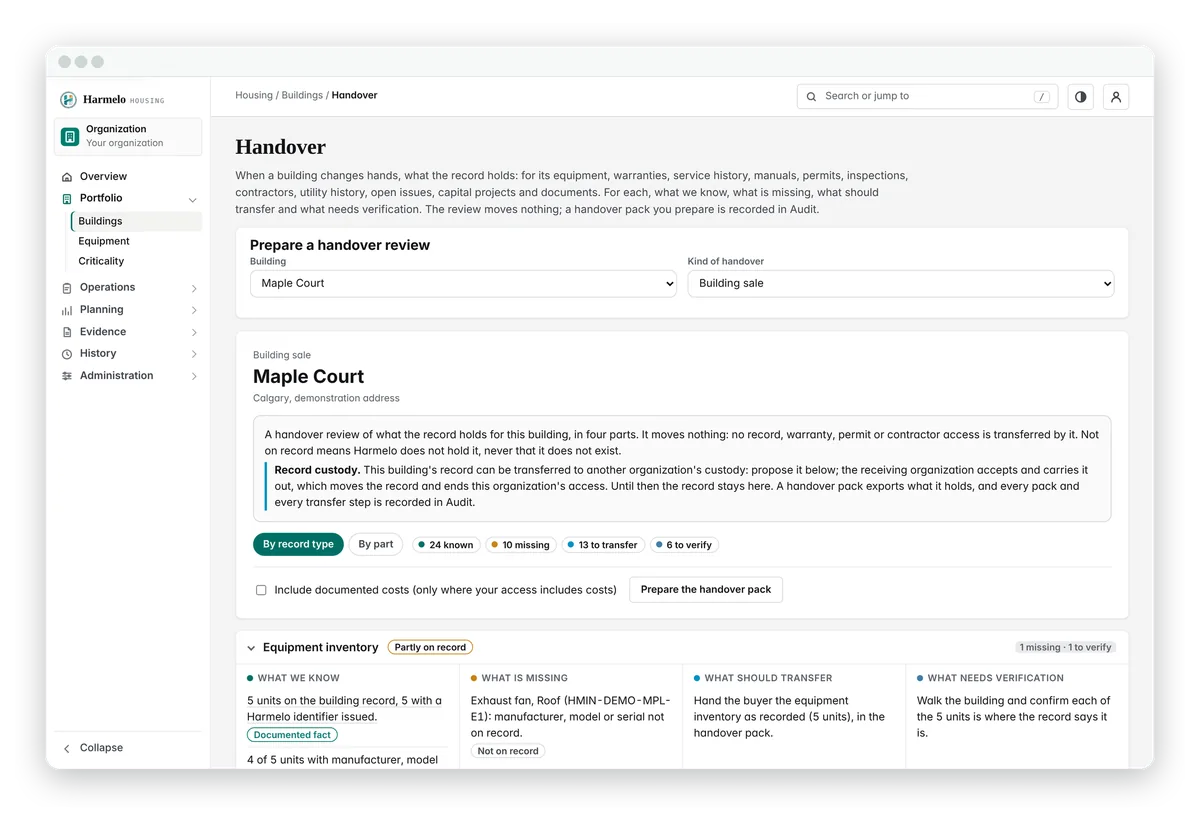
Sell the building without deleting its memory.
- What transfers. Building identity, equipment records, service history, evidence, warranties, permits and inspections on record, capital projects, replacement history, handover documents, and where each fact came from. The outgoing organization's Audit stays with it, and both organizations' Audit records the transfer.
- What stays. Private and internal working notes, another party's confidential material, contractor access, and the outgoing organization's own portfolio planning.
- How it happens. The outgoing organization proposes, the receiving organization accepts and carries it out, and the outgoing organization's access ends. Every step is recorded in Audit.
An authorized handover, in the product.
- Propose. The outgoing organization proposes the transfer to the receiving organization's transfer code, with a manifest of what moves and what stays.
- Accept. The receiving organization accepts or declines it. Only an organization with governed roles and permissions can accept a building into its custody.
- Carry out. The receiving organization confirms, and the record moves with its service history, documents and register entries. Copies are made before anything is removed.
- Access ends. The outgoing organization's access to the building ends, and both organizations' Audit records it.
Your building should not forget because your subscription changed.
When an organization's paid service ends, Harmelo staff move its account to read-only. It is not deleted and it is not locked away. Reactivating returns the same record.
Still available, read-only
- Sign in
- Review every building, its equipment and its full history
- Download the documents, reports and exports already on the record
- See billing status
- Ask Harmelo to reactivate paid service
Paused until you reactivate
- New records, edits and uploads
- Contractor and technician submissions
- New exports, report packages and IDRs
- Integrations and automation
- Paid intelligence and planning tools
Read-only access applies to Harmelo organization accounts. Closing an account entirely is different: the Terms of Use and Privacy Policy describe what happens to its data then.
Continuity, not uncontrolled sharing. Records remain governed, access is permissioned, transfers are authorized, provenance stays intact, and private information does not follow the building where it should not.
Evidence and trust
Governed like evidence, so others can rely on it.
Harmelo was started by a heating and cooling contractor who spent years in the mechanical rooms of homes and buildings, watching the same history get lost. It is built to the standard an owner, a lender or an auditor would hold it to.
- Every fact has a class and a source: documented, technician observation, entered, engineering assessment, planning assumption or not documented.
- A person decides what changes the record: candidate facts wait in evidence review until someone accepts or rejects them.
- Every action is in the audit history: who filed, reviewed, shared or prepared what, and when.
- Gaps are stated, not hidden: what is not documented is named, with what would resolve it.
- Your information stays yours: the organization holding the record decides who reads and writes it.
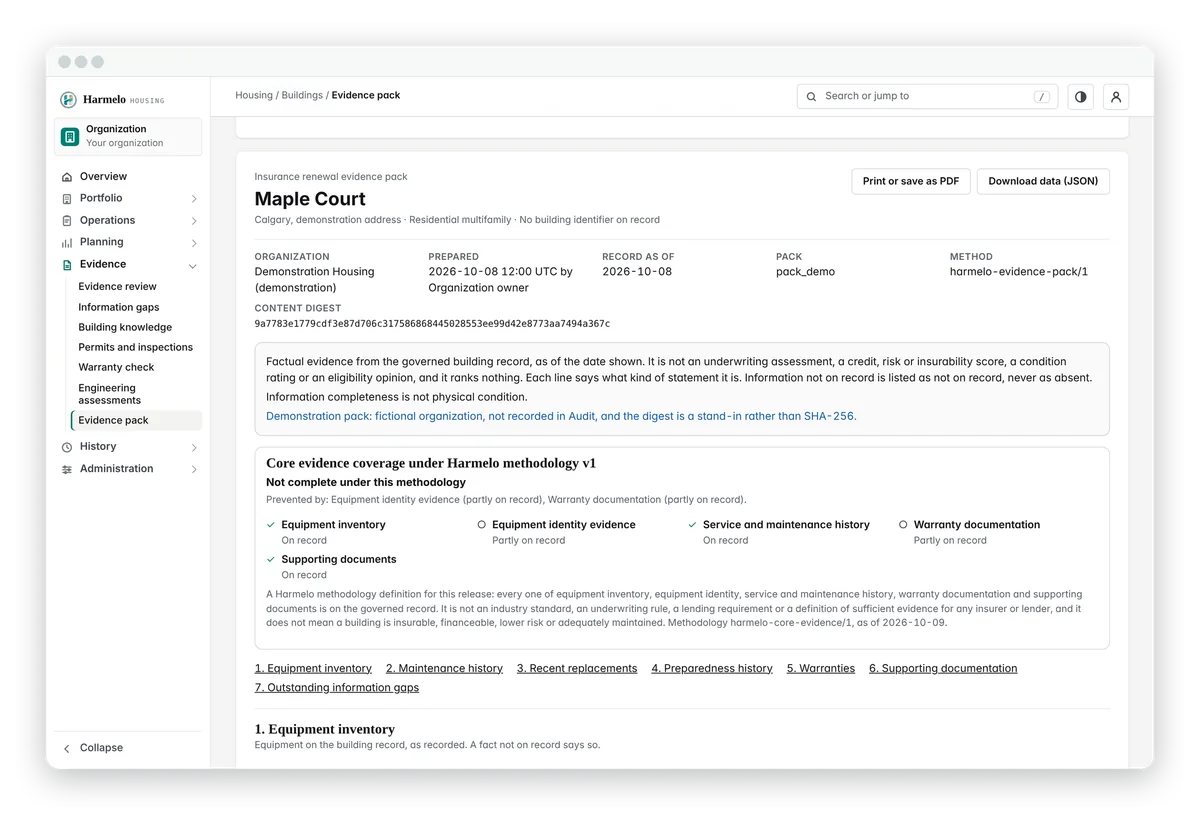
A record everyone can work from. Harmelo keeps service history connected to the building, so owners, contractors, tradespeople and portfolio teams can understand what happened, what changed and what needs attention next.
- Facts, not rankings. Harmelo preserves documented work. It does not rank contractors or sell preferred placement.
- Work that stays connected. Service notes and history remain attached to the equipment, creating continuity across visits, contractors and ownership changes.
- Clear boundaries. Harmelo does not certify work quality or promise leads. Participation does not give Harmelo ownership of a stakeholder's underlying information.
Next step
See Harmelo on buildings like yours.
Tell us what you are responsible for. Someone from Harmelo will reply to arrange a virtual walkthrough of the workspace, the field app and the reports, using demonstration data, or to scope a pilot on a few of your buildings.
- No account is created and nothing is installed.
- Your details are used only to reply to this request.
- Running a service company? The contractor request asks about your crew and service area.
- Want a figure first? Estimate pricing for your portfolio or team.