See every public building system. Plan the capital. Show where the money went.
A verifiable, longitudinal record of the mechanical, energy, and envelope systems inside public housing, government facilities, and civic buildings, built to survive administrations, contractor changes, and program cycles. Facilities teams plan capital on real condition instead of age charts, and the programs that fund building upgrades can see the outcome of that spend, not just that a cheque cleared. You can produce a building's Infrastructure Disclosure Report (IDR) yourself, from records you already hold, before any procurement begins.
Public infrastructure runs for decades. Its records rarely survive a single change.
Governments steward building systems across public housing, office buildings, courthouses, schools, and civic assets. The buildings are documented. The financial position is known. But the equipment inside, the part citizens depend on, is governed by records that fragment with every administration, contractor change, and program transition.
The whole portfolio, scored and forecast. Not a binder nobody can find.
Contractors log their work in the field and it flows straight into the record, signed and dated. It stays with the building through every operator change, contractor rotation, and administration, so the record an oversight review draws from is the same one your team plans from. Nothing resets at a transition.
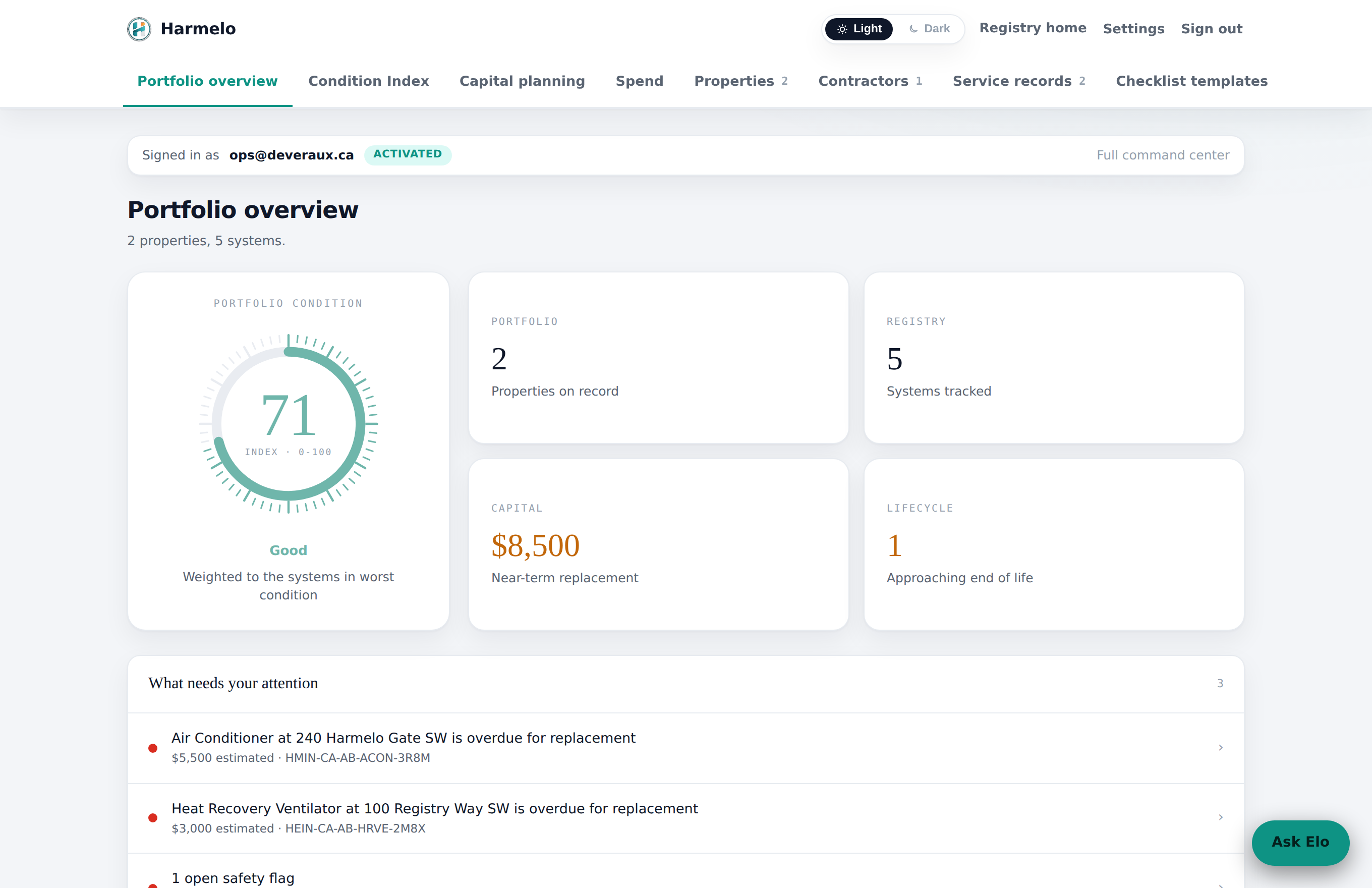
Condition across the portfolio
Every system scored from 0 to 100, with the buildings and systems most at risk surfaced first.
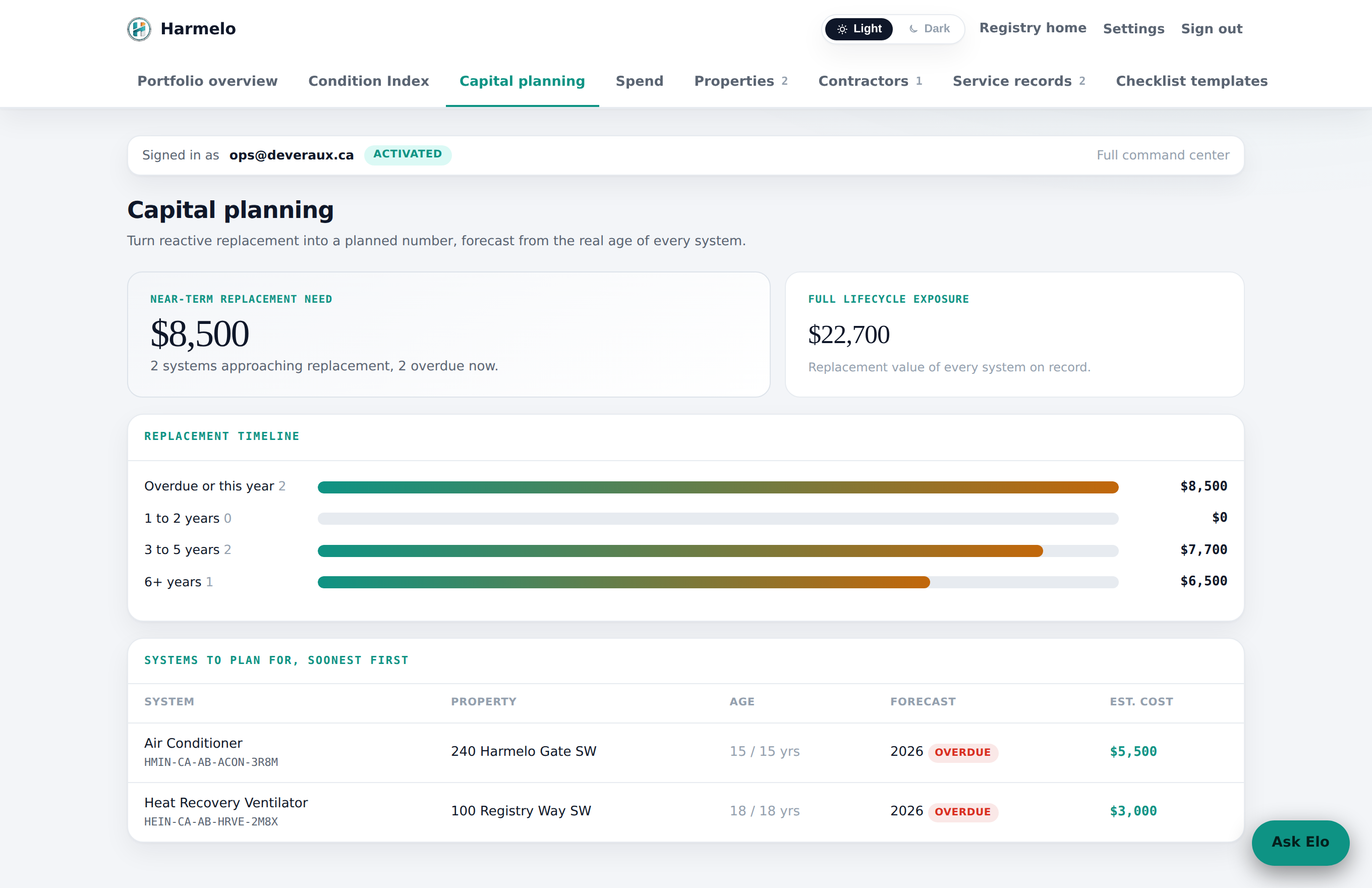
Capital you can defend
Replacement timing and cost forecast by year, so a multi-year plan holds up to a review line by line.
It doesn't replace your operations software. It's the record layer beneath it.
Government facilities teams already run operations and maintenance management systems for tenants, work orders, and accounting. Harmelo doesn't compete with those, it sits underneath them as the neutral, persistent identity layer they read from. The two answer different questions.
| Category | Operations / Management Software | Harmelo |
|---|---|---|
| Core layer | Operations | Infrastructure identity |
| Focus | Tenants, leases, accounting | Equipment, systems, lifecycle |
| Data ownership | Platform / operator dependent | Asset-bound, persistent |
| Continuity | Breaks across changes | Survives changes |
| Role | Workflow + management | Governance + record layer |
| Replacement? | No, sits underneath your existing system |
No rip-and-replace. No new operator workflow. Identity attaches during the install and service activity already happening across your portfolio.
One registry. Scaled to your portfolio.
Harmelo engages with governments through models scoped to portfolio size, program priorities, and procurement structure. Audit engagements precede commercial structures, pricing is shaped to the engagement, not pre-set.
Every engagement is scoped to your portfolio size, program priorities, and procurement structure, pricing is shaped to the work, not pre-set. The right place to start is a conversation about what your fiscal window and asset base actually need.
Contact us about an engagement →Built for how governments actually manage infrastructure.
From public housing portfolios to cross-agency coordination, the same registry serves every layer of public stewardship, across Canadian and U.S. governments alike.
Public money, you can account for.
Governments answer to taxpayers, auditors, and the administrations that follow, for decisions made on infrastructure that runs long after any single budget cycle. A persistent, verified record strengthens that accountability at every level, and it is the kind of infrastructure that serves a public purpose well beyond any one owner.
Program spending you can measure
Public programs put billions into building upgrades and electrification. A registry lets a funder see the condition and outcome of that spend across the buildings it actually touched, not just that the money went out the door.
A grid you can see coming
As heat pumps, solar, batteries, and EV charging are added to public buildings, HEIN tracks those energy assets, so the load being added to the grid is documented and visible instead of a surprise later.
A made-in-Canada standard
One common record that every level of government, every operator, and every contractor can read the same way, built in Canada, so the way the country's public buildings are documented can be a home-grown standard rather than an import.
Smarter purchasing over time
As the record grows, it shows which equipment actually holds up in the field, so procurement can favour what performs instead of what looked cheapest on paper.
Start with a scoped audit.
You can begin right now, on your own. Take one building, upload the records you already hold, and read the Infrastructure Disclosure Report it produces, before any procurement or commercial conversation. For a broader rollout across a region, housing authority, or facility type, a scoped engagement follows, sized to your portfolio and procurement process within a defined fiscal window.